Settings & data
Models and language
updated
The two transcription choices — which Whisper model runs and which language it expects — plus what you see while a model is being prepared.
Transcription has two settings and no more: which model runs, and which language it should expect. Both live on the Transcription tab of the Oris app, and the defaults are the right answer for most people.
What you choose
- Transcription model — a dropdown of the available models, with Large v3 Turbo (recommended) as the default, plus a Custom… option that accepts a free-text model name. Larger models are more accurate but slower, and the default is a good balance.
- Language — the spoken-language hint. The default is Auto-detect (recommended), where Oris infers the language from the first few seconds of audio. To force a specific language, choose from the list (English, Spanish, French, German, Italian, Portuguese, Dutch, Japanese, Chinese, Korean) or type a language code into the Custom field. Transcription handles far more languages than the list shows, and summary quality depends on the provider and model you picked.
While a model prepares
Oris transcribes on your Mac, which means the first time it runs a model (and occasionally afterward) macOS has to prepare that model for the Neural Engine. That preparation is a one-time cost, but it can take a few minutes, and a silent few-minute wait is indistinguishable from a hang. This is the progress feedback that makes the wait legible.
During setup. The guided walkthrough’s model step shows a live strip: a download percentage for each model as it’s pulled down, and, once the download finishes, an explicit Compiling for the Neural Engine label so a bar sitting at 99% reads as “still working,” not stuck. When it’s done, the strip reports how long each phase took, so you can see where the minutes actually went.
During a recording. Most of the time the model is already warm and transcription starts instantly. But a model can go cold after a macOS update, or after a long stretch of not recording, and then Oris has to re-prepare it right when you stop a recording. When that happens the Obsidian status bar shows ⏳ preparing model…, so the wait reads as preparing rather than broken. It clears the moment real transcription begins.
Offline, once the model is on disk. Loading a downloaded transcription model is pure local work: Oris checks its own model cache first and reaches for the network only when that cache is genuinely missing something. A recording stopped on a plane, behind captive-portal Wi-Fi, or during an ISP blip transcribes exactly like one stopped on a healthy connection. The one transcription case that does need the network is a model that isn’t fully on disk yet (a first run, a switched model, an interrupted earlier download) — and then the status bar says ⬇ downloading model… honestly instead of leaving “preparing” to spin.
For longer meetings. A long transcript may call for a larger summarization model than the one set up during onboarding, and that larger model is fetched the first time it’s needed. That download can be several gigabytes, so instead of a silent pause the status bar shows ⬇ downloading model…, and since you may not be looking at Obsidian at all, Oris also posts a one-time notification telling you it’s downloading a summarizer model and your notes will follow when it’s done. Any live recording that needs a summarizer model Oris hasn’t downloaded before gets the same heads-up, and a longer recording calling for a bigger model is simply the most common reason. (An imported audio file can trigger the same first-use fetch, but shows it in its import progress indicator instead of this banner.) Once it’s downloaded it stays cached, so the wait is a one-time cost per model.
None of this needs any action from you. It’s feedback, not a step. The point is simple: whether it’s your very first recording or your longest meeting yet, Oris tells you it’s working instead of leaving you guessing.
Where settings live
Oris settings live in the Oris app, not in the Obsidian plugin. Open the app after the setup walkthrough and its home window is the settings manager.
The Obsidian plugin is a thin recording trigger. It starts and stops recordings and reserves the spot in your note where the transcript lands. Everything else, meaning provider, API keys, transcription model and retention, is configured in the app.
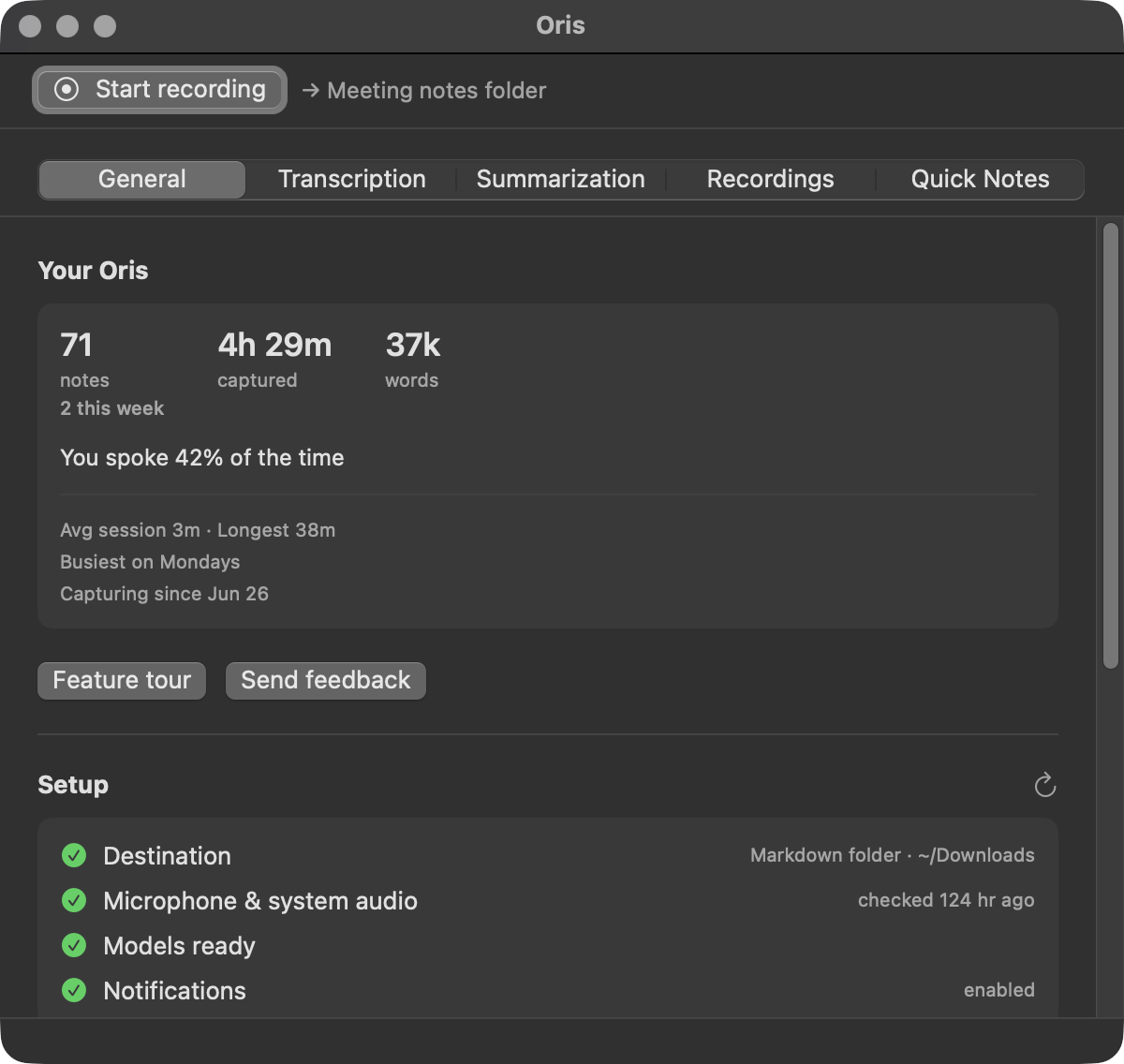
The home window is organized into tabs:
- General — setup status, walkthrough controls, updates, build info
- Transcription — transcription model, language
- Summarization — provider selection, credentials, fallback order, connection tests
- Recordings — recent recordings and full history, audio retention, auto-stop on silence
- Quick Notes — Quick Note: the master switch, destination, activation mode, hotkey, speech engine, AI cleanup, and the quick-notes viewer
Below every tab sits the Oris Pro signup banner — or nothing but a small Pro chip in the title bar, once Pro is on.
How it works underneath
Every control on the General tab
- Your Oris — a stats card summarizing how you have used Oris so far. See Your Oris.
- Destination — where your meeting notes, quick notes, and imports land: an Obsidian vault, a Markdown folder, or Apple Notes. A file destination reports its kind and its path; when something is wrong, such as a vault or folder that moved or a store Oris can’t read, the row says exactly what, so you find out before a recording does. Quick notes follow this same destination; whether a capture is written into it or kept in Oris’s own inbox is the placement choice on the Quick Notes tab. A “Quick notes: …” caption appears under the row only in the odd state where quick notes are routed somewhere other than the destination shown — a healthy setup shows nothing extra. If you’ve switched away from a destination that still has notes waiting to reach it, a line says how many and points at Recordings. Change… opens a sheet to switch: pick a new destination from the same cards the walkthrough shows and click Save. See Obsidian and Markdown.
- Setup status — a compact health summary of what’s left to confirm: plugin install (Obsidian destinations only), microphone and system-audio permissions, model warmup, and notifications. It loads quietly on every app open, and no animation runs unless you explicitly request a re-check.
- Apple Notes automation — present only when your destination is Apple Notes. It reads allowed, not set up yet, turned off, or not checked, and its button is the fix for that state: Grant access raises the one macOS prompt when the permission has never been asked for (a caption explains the ask first, and the row updates itself with the answer), and Open System Settings opens the Automation pane when it has been turned off, with the re-check running on its own when you come back to Oris. A quiet Check again link re-reads the answer without asking anything. Not checked is where the row usually rests until you ask: reading the answer means launching Notes, and opening a settings tab is not a reason to open Notes, so Oris reads it by itself only when Notes happens to be running already; with Notes closed the row waits for its Check button. See Apple Notes.
- Re-check permissions — runs the test capture in place, the same ~8-second capture the walkthrough uses, without requiring a full walkthrough re-run. Use this after adjusting audio routing or system-audio settings to confirm both tracks are live.
- Notifications — shows whether Oris is allowed to post notification banners for notes-ready, auto-stop and summary-failed. Banners are posted by the recorder, so if you denied the notification prompt, or later revoked it in System Settings, banners silently stop and this row flags it. It has its own Re-check button and, when notifications are off, an Open System Settings → Notifications link so you can re-enable Oris.
- Feature tour — opens the in-app tour of what Oris can do. See Feature tour.
- Send feedback — opens the feedback sheet. See Send feedback.
- Re-run walkthrough — resets walkthrough progress so you can step back through plugin install, permissions, and model warmup. It’s for repairing a setup that’s stopped working, not for switching destinations on purpose: a destination that’s already working fast-forwards past itself, the same as any other finished step. To change where notes land deliberately, use the Destination section’s Change… button above instead.
- Updates — an Automatically check for updates toggle, on by default, so Oris checks daily in the background and prompts you to install when a new version is found. Next to it is a Check for Updates… button to check right now. See Updates.
- Share anonymous system info — on by default. The daily update check carries a small profile: macOS version, Mac model and CPU, your app and update-tool versions, preferred language. That list is the whole of it, never your audio, recordings, or notes. Turn it off and the update check still runs, just without the profile.
- Version footer — current build info.
Destination changes are the one exception to the rule below: the sheet has its own explicit Save button, because a destination write can install the Obsidian plugin, move where your recordings folder lives, or create a note the moment it’s confirmed — side effects that shouldn’t fire on a keystroke. Everywhere else on this tab, there is no Save button. Changes persist on their own, a toggle or a dropdown the moment you flip it and a text field a moment after you stop typing, and a brief “Settings saved” confirmation appears when it lands. A change you made in another window isn’t reverted by an unrelated change you make here.
That confirmation belongs to Transcription, Summarization, Recordings, and Quick Notes. General’s two preferences, Automatically check for updates and Share anonymous system info, take a different route: they save the instant you flip them but show no banner.
One combination is deliberately held back rather than written: a Quick Note destination of Pinned note with an empty note path. The form keeps showing your selection and the Quick Notes tab explains why, but what actually gets saved is the in-app-inbox default, which is exactly where captures would land anyway. Fill the path in and it saves normally.